Master acoustic simulation to predict sound behavior and optimize architectural designs. Learn practical workflows to mitigate risk and ensure performance before construction begins.
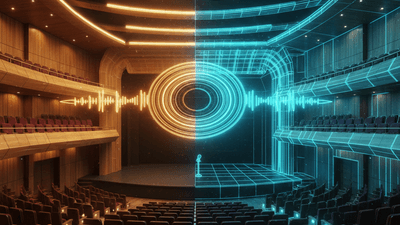
Sound behavior is a critical, yet often overlooked, dimension of architectural design that fundamentally shapes occupant well-being and building performance. In Introduction to Acoustic Modeling and Simulation, instructor Amr Abouseif guides learners through the essential principles and practices of integrating acoustic analysis into the architectural workflow.
Moving beyond basic theory, this course explores the practical application of digital tools that empower architects and engineers to predict sound environments, mitigate risks, and optimize designs before physical construction begins.
Historically, acoustic design was a niche concern reserved for performance venues. Today, it is recognized as a vital pillar of modern architecture, influencing:
Productivity in open-plan offices
Learning outcomes in educational facilities
Recovery and comfort in healthcare environments
The course provides a deep dive into the physics of wave propagation, reflection, and absorption, explaining how room geometry and material selection shape the auditory experience.
You will explore the landscape of computational acoustic modeling, comparing Geometric Acoustics methods such as Ray Tracing and Image Source Modeling with wave-based approaches such as Finite Element Analysis (FEA) and the Boundary Element Method (BEM).
Through detailed technical explanations and real-world examples, the course outlines the complete simulation workflow. Learners will discover how to:
Prepare watertight 3D geometries
Assign frequency-dependent material properties
Configure sound sources and receivers
Interpret acoustic simulation outputs
Read heat maps and reverberation data
Diagnose issues such as flutter echoes and poor speech intelligibility
Real-world case studies, including the renovation of auditoriums at Ain Shams University and Helwan University, demonstrate how these strategies can be applied to identify and resolve complex acoustic defects in existing buildings.
Understand the physics of sound, including frequency, wavelength, and how sound interacts with architectural boundaries.
Differentiate between modeling methods such as Ray Tracing, FEA, and Statistical Energy Analysis (SEA) and select the appropriate method for different building typologies.
Execute a professional simulation workflow, from project setup and geometry creation to material assignment and calculation.
Analyze simulation results and verify compliance with performance metrics such as Speech Transmission Index (STI) and Reverberation Time (RT).
Apply acoustic zoning and material-selection strategies to optimize both cost and performance.
Explore emerging industry developments, including the integration of Artificial Intelligence, Generative Design, and Building Information Modeling (BIM).
This course is designed for professionals and students who want to move beyond reactive acoustic problem-solving toward proactive performance optimization.
By mastering digital acoustic prototyping tools, you will learn to treat acoustics as a core design parameter—helping ensure that architectural projects are not only visually striking, but also acoustically effective.

Architect & Planner, MAA, MA, B.Arch., PMP®, LEED AP® BD+C, MRAIC
Amr is a registered architect and certified Project Management Professional (MAA, MA, B.Arch., PMP®, LEED AP® BD+C, MRAIC) specializing in professional development education for the AEC industry. Amr has established expertise in bridging traditional engineering disciplines with emerging technologies including artificial intelligence, BIM methodologies, digital construction, and sustainability practices. Amr's courses combine rigorous technical accuracy with practical implementation guidance, drawing from authoritative sources like ASHRAE, NIST, IEEE, and ASCE. Amr focuses on emerging areas where practitioners need guidance most: AI-powered construction systems, digital twins, climate resilience, robotic automation, and advanced computational design. By developing thought leadership content at the intersection of traditional practice and cutting-edge innovation, he helps thousands of engineering and architecture professionals stay ahead of industry evolution while meeting their continuing education requirements.
