LF logo
by learnformula
search
Log in
search
Courses/Business/Business Performance and Improvement

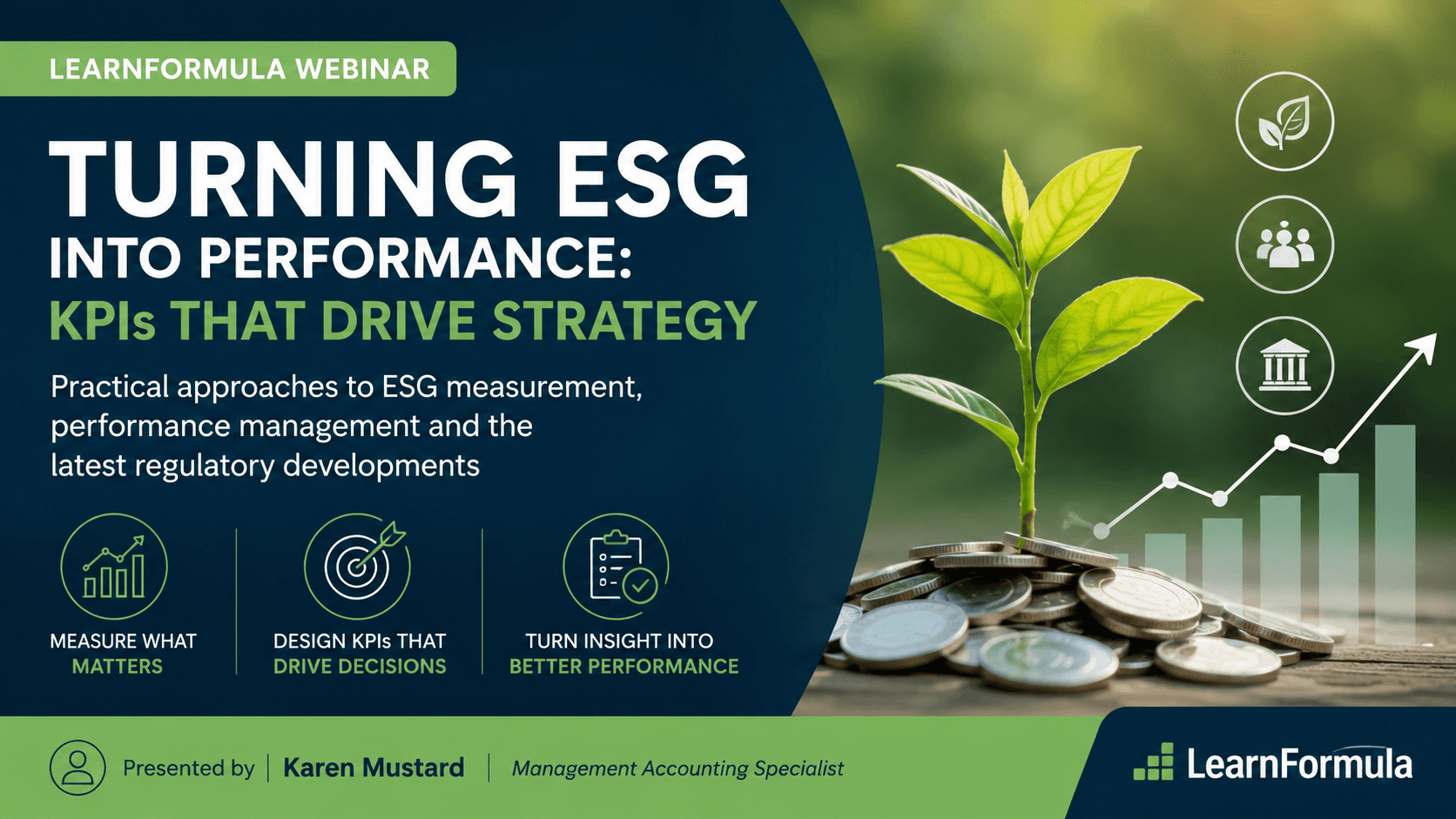
Turning ESG into Performance: KPIs That Drive Strategy

Transform ESG from a compliance checklist into a competitive advantage by mastering metrics that align corporate responsibility with measurable financial growth.
Created byKaren Mustard
BeginnerUpdated Jul 14, 2026
Turning ESG into Performance: KPIs That Drive Strategy

What You'll Learn

check_circleAssess how ESG metrics support value creation and strategic decision-making
check_circleConvert ESG strategy into meaningful, measurable KPIs
check_circleApply performance measurement techniques to improve ESG reporting
check_circleInterpret the key requirements of IFRS S1 and IFRS S2, including Scope 1, 2, and 3 emissions reporting
check_circleDesign effective ESG KPIs that support business performance rather than simply meeting reporting obligations
check_circleEvaluate ESG reporting challenges and opportunities for SMEs and growing businesses

About This Course

Environmental, Social and Governance (ESG) has rapidly evolved from a compliance issue into a strategic business priority. While reporting requirements continue to change, organisations of every size are increasingly expected to demonstrate how sustainability influences business performance, risk management and long-term value creation.

This webinar explores how management accountants can move beyond ESG reporting and play a central role in designing performance measures that support better decision-making. Rather than focusing solely on disclosure requirements, you will learn how to develop meaningful Key Performance Indicators (KPIs) that connect sustainability initiatives with organisational objectives and commercial outcomes.

You will discover how to identify the sustainability measures that matter most, avoid common mistakes in KPI design and use management accounting techniques to evaluate the costs, benefits and strategic impact of ESG initiatives.

What you will learn

By the end of this webinar, you will be able to:

  • Understand why ESG has become a management accounting and performance management issue.
  • Distinguish between ESG reporting metrics and KPIs that genuinely drive business performance.
  • Design practical sustainability KPIs aligned with organisational strategy.
  • Apply a structured approach to evaluating the costs and benefits of ESG initiatives.
  • Recognise the latest developments in sustainability reporting,
    • UK Sustainability Reporting Standards (UK SRS) and ISSB Standards (IFRS S1 & IFRS S2)
    • Implications of the EU Corporate Sustainability Reporting Directive (CSRD) and the Omnibus reforms.
    • Scope 1, 2 and 3 emissions
  • Prioritise ESG initiatives using value-versus-effort analysis
  • Prepare for evolving stakeholder expectations beyond compliance
  • Align ESG metrics with commercial outcomes and business value

Your Instructor

Karen Mustard
Karen Mustard

Management Accounting | Performance Management | Sustainability & ESG Expert

menu_book1 courses

I specialise in Management Accounting, with particular expertise in performance management, sustainability, and ESG reporting. I am ESG Institute-certified in ESG reporting and the author of Management Accounting. My focus is on translating complex concepts into practical strategies that improve organisational performance, support informed decision-making, and drive sustainable business success. Through my courses, I provide professionals with relevant, actionable knowledge for today's evolving business landscape.

Credit Information

What Students Are Saying

0.0
Student's Choice
0 reviews

Frequently Asked Questions

We are a registered provider with 327+ associations and regulatory bodies worldwide. We operate across 29 global markets including Canada, the US, Australia, and the UK. Every course page clearly displays its specific accreditations. Upon completion, you receive a professional certificate that can be validated online. Our certificates include all necessary accreditation details, credit hours, and completion dates, and are formatted specifically to meet the submission requirements of most global regulatory bodies.