
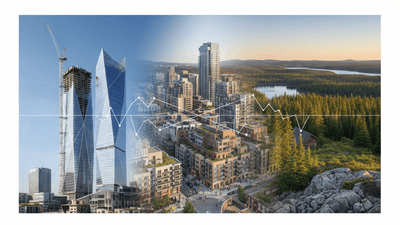



Canada’s architectural and developmental landscape is currently defined by a profound tension: the unstoppable momentum of modernization colliding directly with the immovable realities of environmental and agricultural preservation. As the nation races to accommodate a growing population and upgrade aging infrastructure, architecture and urban planning professionals find themselves at the epicenter of a complex balancing act. From billion-dollar waterfront facilities to intense debates over intercity transit, the decisions made today will permanently alter the Canadian footprint.
The Infrastructure Dilemma: Progress vs. Preservation
A stark reminder of this friction comes from ongoing protests where farm leaders are calling for a halt to a proposed high-speed rail project that threatens to slice through prime agricultural land. While high-speed rail is frequently championed by urban planners as the ultimate sustainable transit solution, this conflict exposes the localized environmental costs of macro-level "green" infrastructure.
For architectural professionals, this debate is far more than a political talking point; it represents a fundamental shift in how large-scale infrastructure must be approached. We can no longer design transit hubs or linear infrastructure in a vacuum. The architectural mandate now requires:
- Holistic Land-Use Planning: Integrating agricultural impact assessments into the earliest stages of schematic design.
- Elevated Transit-Oriented Development (TOD): Designing stations that maximize density within existing urban boundaries to offset the ecological footprint of the connecting rail lines.
- Stakeholder Mediation: Acting as the bridge between aggressive government infrastructure targets and protective community/agricultural coalitions.
"The future of Canadian infrastructure cannot be built at the expense of its foundational resources. True architectural innovation lies in finding the spatial compromises that allow both transit and agriculture to thrive."
Civic Ambitions and Waterfront Revitalizations
While rural land-use debates rage on, provincial governments are simultaneously doubling down on legacy civic projects in dense urban centers. A prime example is the recent announcement that the province has awarded a massive $1.04 billion contract to Ontario Science Partners for a new waterfront facility.
Projects of this magnitude signal robust confidence in the architectural sector, but they also come with intense public scrutiny. Waterfront developments are historically contentious, requiring architects to master the art of "placemaking." This facility will demand a delicate integration of public accessibility, climate-resilient shoreline design, and state-of-the-art scientific infrastructure. For firms looking to secure municipal and provincial bids in 2026 and beyond, demonstrating expertise in flood-mitigation and public-realm integration is no longer optional—it is the baseline.
Urban Densification Done Right: The Granville Street Model
If sprawling infrastructure presents a land-use crisis, intelligent urban densification offers a potential antidote. By building up and mixing uses, architects can help cities absorb population growth without paving over vital greenbelts. In Vancouver, the 800-Block Granville Street redevelopment by Perkins&Will is moving forward, providing a masterclass in modern urban intensification.
This project is particularly notable for Canadian architects because of its sheer programmatic density. It is slated to include 550 rental homes while seamlessly integrating heritage facades, entertainment venues, retail, hospitality, and community spaces. The Granville Street project exemplifies the "15-minute city" philosophy in practice.
Key Architectural Takeaways from Granville Street:
- Heritage as an Asset, Not a Hindrance: Retaining historical facades maintains neighborhood character while allowing for high-density vertical growth behind and above the original structures.
- Hyper-Mixed-Use Zoning: Moving away from monolithic residential towers toward dynamic, multi-layered programming that keeps streetscapes active 24/7.
- Rental Densification: Addressing Canada's housing crisis directly through purpose-built rental architecture that prioritizes long-term livability over short-term condo-investor appeal.
Institutional Expansion and Material Realities
The push for density and modernization extends well into the institutional sector. In Alberta, vertical construction has officially begun on the 170,000-square-foot Werklund Centre expansion in Calgary. As educational facilities compete globally, the architecture of these spaces is evolving to prioritize collaborative, tech-enabled environments that foster innovation.
However, this nationwide boom in infrastructure, civic, and institutional construction requires an immense volume of raw materials. The supply chain and material science sectors are adapting rapidly, evidenced by the fact that the Canadian Concrete Expo 2026 set sweeping records for attendance, exhibitors, and educational participation. For architects, this signals a critical opportunity. The record engagement at the Concrete Expo highlights a hungry industry eager for new, low-carbon concrete alternatives, advanced pre-fabrication techniques, and smarter construction methodologies. Firms that leverage these material advancements will not only reduce project timelines but significantly lower the embodied carbon of their mega-projects.
Comparing Canada's Development Strategies
To understand the current architectural landscape, we must look at how different development strategies are interacting across the country:
| Development Strategy | Architectural Focus | Primary Challenge |
|---|---|---|
| Intercity Infrastructure (e.g., High-Speed Rail) | Transit-Oriented Development, Station Design | Ecological disruption, agricultural land loss |
| Urban Densification (e.g., Granville Street) | Mixed-use, Heritage Integration, Rental Supply | Zoning complexities, community displacement |
| Civic Mega-Projects (e.g., Waterfront Facilities) | Placemaking, Climate Resilience, Public Accessibility | Budget overruns, intense public scrutiny |
Human Capital: Equipping the Next Generation of Leaders
Who will lead these complex, multi-layered projects? The architectural industry is actively reshuffling its ranks to meet these challenges. Recently, numerous Canadian architecture firms have recognized top talent with strategic staff promotions and appointments.
These promotions are not merely administrative updates; they reflect a shifting priority within the profession. Today’s newly minted Partners and Principals are increasingly individuals who possess hybrid skill sets—architects who are as comfortable navigating municipal zoning bylaws and environmental impact assessments as they are drafting parametric facades. The elevation of this talent underscores the industry's recognition that the future of Canadian architecture requires fierce advocates, savvy politicians, and visionary designers rolled into one.
Looking Ahead
As we move deeper into 2026, the Canadian architectural profession stands at a critical juncture. The friction between a high-speed rail line and a farmer's field is not an isolated incident; it is the blueprint for the conflicts architects will mediate for the next decade. By embracing hyper-dense, mixed-use models like Vancouver's Granville Street, leveraging new material technologies celebrated at industry expos, and nurturing adaptable leadership, Canadian architects can successfully design a future that honors both our need for progress and our duty to preservation.